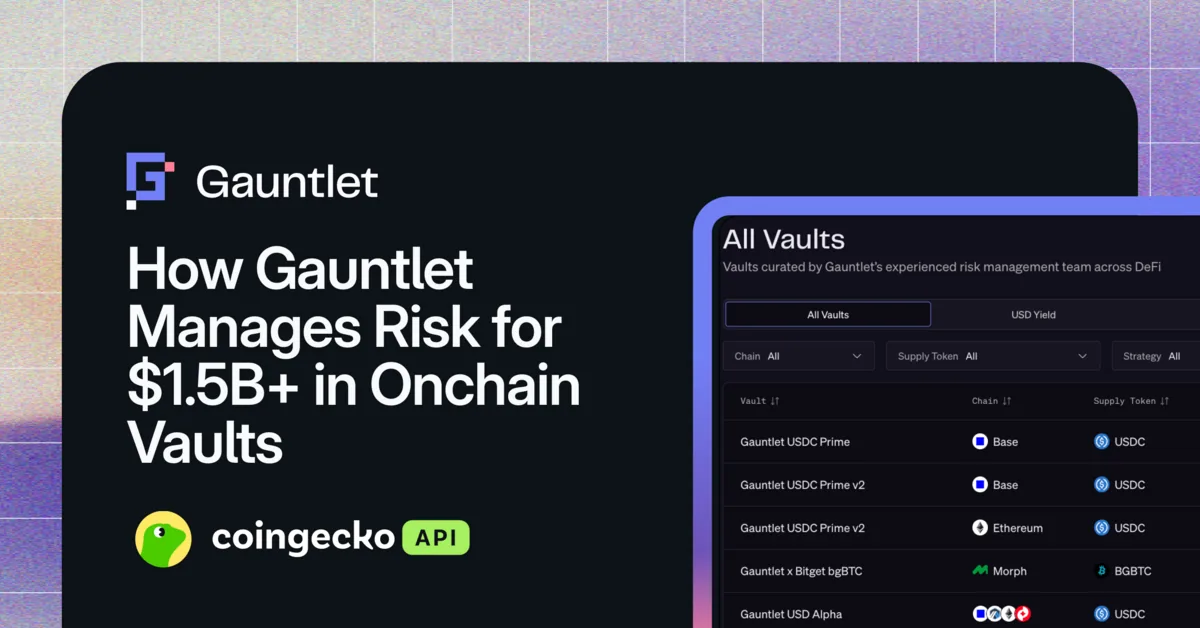
Gauntlet is the leading quantitative risk manager in crypto. It builds optimization strategies and platforms for protocols, applications, and chains, while its economic risk models protect billions in decentralized finance. The same research and risk expertise now powers Gauntlet’s onchain vaults, both those curated on protocols such as Morpho and those running on Aera, Gauntlet’s first-party vault infrastructure, which deliver risk-adjusted yield to vault suppliers.
Today, more than $1.5B is allocated across these strategies, serving more than 50,000 users directly, and many more via partners. To price risk and value collateral, Gauntlet uses the CoinGecko API as a pricing layer for its quantitative risk models and the Gauntlet App, providing reliable market data for risk analysis and asset valuation.
Key Metrics at a Glance
- Gauntlet’s economic risk models cover billions in DeFi, while its onchain vault strategies have $1.5B in allocated assets across more than 50,000 users.
- CoinGecko API powers live vault supply figures, individual vault allocations, and portfolio valuations in the Gauntlet App and is a core component of the Gauntlet API/SDK.
The Challenge: Pricing Risk Across Blue-Chip and Emerging Collateral
As Gauntlet evaluates new collateral options for its onchain vaults, it needs dependable data to assess asset value, liquidity, and risk. That challenge becomes more complex across DeFi’s broad range of assets, from established blue-chip tokens to newer crypto-native assets. A vault might hold established, deeply liquid tokens one day and a newer crypto-native asset being evaluated as collateral the next. Both require dependable market data to inform risk and valuation decisions.
Gauntlet needed a single provider able to cover both ends of that spectrum, without stitching together multiple sources, with the speed and reliability to run inside live production systems. Beyond a headline price, Gauntlet also needed visibility into the specific liquidity pairs and trading venues behind each asset.
This needs now extend to newly emerging onchain assets such as stablecoins, RWAs, and other tokenized instruments.
Why Gauntlet Chose CoinGecko API
CoinGecko’s market data spans prominent blue-chip tokens and longer-tail crypto-native assets, aggregated across centralized and decentralized exchanges rather than relying on a single venue. Through the CoinGecko API, Gauntlet accesses this data programmatically for its live risk models and the Gauntlet App.
What Gauntlet Says About CoinGecko API
"CoinGecko is a foundational data provider for Gauntlet. Its pricing and market data support timely risk decisions, from evaluating new collateral to monitoring deviations between market and oracle prices, while its historical data helps us backtest and refine strategies. It also powers numerous metrics across the Gauntlet App and serves as a core component of our API/SDK."
— Rei Chiang, Chief Technology Officer at Gauntlet
How Gauntlet Leverages CoinGecko API
CoinGecko data supports Gauntlet’s quantitative risk models for asset selection and risk monitoring, while providing the market data displayed to vault suppliers in the Gauntlet App.
Vault and Portfolio Valuation Across the Gauntlet App
Each vault’s total supply is displayed in USD alongside its net APY, contributing to the overall Total Value Locked across Gauntlet’s vaults. CoinGecko’s /simple/token_price/{id} endpoint provides token prices by contract address, batching many tokens into a single request per chain. This allows Gauntlet to efficiently retrieve the data needed to value multiple assets across the Gauntlet App.
Vaults: Total Value Locked and per-vault supply in USD
At the position level, a vault’s Allocations tab breaks that same valuation down by protocol and asset, showing exactly how much capital is allocated to each. On the Portfolio page, connected wallets show the live USD value of idle assets held across multiple chains. This gives users visibility into assets that may be available to allocate to a Gauntlet vault. For assets shown in the Portfolio view, Gauntlet uses CoinGecko’s /simple/price endpoint to retrieve current prices for portfolio valuation.
Allocations: Capital allocated across underlying protocols and assets
Idle Assets: Live USD value of assets held outside a vault
Historical Data for PnL Tracking and Strategy Backtesting
Gauntlet uses CoinGecko’s /coins/{id}/market_chart/range endpoint for historical price, market cap, and volume data between specified start and end dates. This data supports historical views of users’ position performance, showing how wallet values have changed over time, as well as Gauntlet’s strategy backtesting.
Position History: Wallet value over time
For tokens identified by contract address, Gauntlet uses /coins/{id}/contract/{contract_address}/market_chart to retrieve historical market data. For a specific past date, it uses /coins/{id}/history to retrieve the corresponding historical price.
Liquidity Analysis and Price Validation for Risk Models
Before treating an asset as vault collateral, Gauntlet uses CoinGecko’s /coins/{id}/tickers endpoint to assess where its liquidity sits across trading pairs and venues, including centralized and decentralized markets. This gives the team visibility into whether liquidity is distributed across multiple markets or concentrated in a single venue or pool.
CoinGecko’s market price also serves as an independent reference in Gauntlet’s live risk systems. When it diverges from an asset’s onchain oracle price, the difference can signal a potential risk event and prompt further monitoring.
Business and User Outcomes
With real-time pricing, historical data, and liquidity data available programmatically, Gauntlet’s team can assess new assets for vault collateral using the same market data across its risk systems.
The pricing feed also supports Gauntlet’s continuous risk monitoring. Its oracle-deviation check compares an asset’s market price against an oracle price, so accurate market data is essential for identifying potential discrepancies.
For vault suppliers, consistent pricing matters across the Gauntlet App. Values such as vault TVL, allocation amounts, and portfolio balances are based on the same aggregated market pricing rather than a single exchange’s view.
What’s Next on Gauntlet’s Roadmap
Gauntlet is expanding its onchain vaults and the infrastructure that supports them. Its roadmap includes growing stablecoin adoption and the expansion of onchain real-world assets, alongside emerging categories such as prediction markets, tokenized equities, and perpetual futures.
These markets introduce new asset types, trading venues, and market structures that require broader market-data coverage. As Gauntlet expands into these markets, CoinGecko’s coverage across established and emerging assets, centralized and decentralized markets, and venue-level liquidity data can support the pricing and risk analysis behind them. This also extends to tokenized equities through real-world asset data covering stocks, ETFs, and commodities, available through the same API.
Get In Touch
Ready to supercharge your crypto project? Fill in the form below to connect with our API Sales team for a custom CoinGecko API plan tailored to enterprise needs.
This article was written in collaboration with Gauntlet team.